What to Look for in a Food and Beverage Production Company
A guide for consumer product brands hiring commercial video production and the questions that actually matter.
Most brands hire a production company the wrong way. They pull up a few reels, compare rate cards, pick whoever looks good enough and fits the budget. It feels like a reasonable process. Then the content comes back and something is off. It looks technically competent but it does not make you want the product. It does not make you feel anything. It just exists.
That is what happens when you treat production like a commodity. For food and beverage brands, the stakes are higher than most categories. Liquid has texture, movement, and energy. A can of soda or a bottle of kombucha has to look alive on screen. It has to create a craving response. That does not happen by accident, and it does not happen with just any crew and a camera.
Here is what to actually look for before you hire.
Specialization Over Range
A strong reel is not enough. The question is what is on that reel.
The physics of shooting a beverage are completely different from shooting a fashion campaign, a talking-head interview, or a lifestyle brand film. Lighting a liquid, capturing a pour, making carbonation look premium on camera — these require a very specific skill set that most generalist production companies simply do not have. They have equipment. They do not have the years of category-specific obsession that turns a competent shot into a craving-inducing one.
Ask to see work specifically in food, beverage, and consumer packaged goods. Not a broad reel. Work in the exact category you are in. Any company serious about this space will be able to show you a deep body of it.
Motion Control Is Not Optional for Beverage Content
Most production companies shoot product on a locked-off tripod or with a handheld operator doing their best to hold steady. For a lot of content, that is fine. For beverage brands that want premium content, it is not enough.
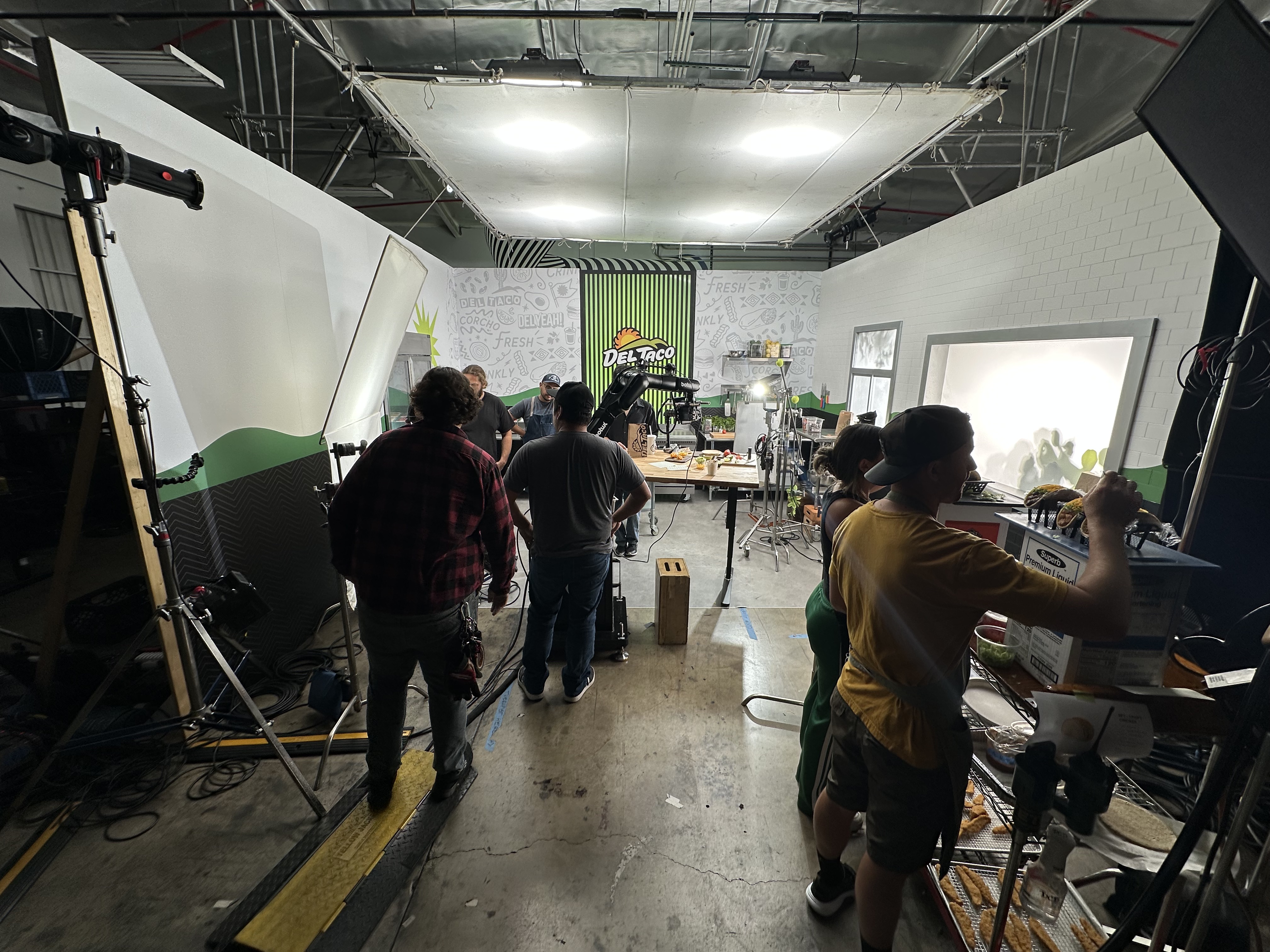
When you want a shot that moves with precision that repeats the exact same arc over a can while you adjust the lighting, swap backgrounds, or composite visual elements you need motion control. You need a robotically programmed camera that executes the same move frame for frame, every single take. That is what makes a perfect liquid pour achievable. That is what lets you capture a carbonation reveal you can actually use in final cut. It is not something you can fake or approximate. Motion control is the difference between footage that looks polished and footage that looks cinematic. If a production company cannot explain specifically how they approach camera movement and product staging, not just what gear they own, but how it serves the content — that is a red flag.
The Questions Most Brands Never Think to Ask
Before you sign anything, ask these four questions. Most brands do not. The answers will tell you everything.
Liquid Is a Character, Not a Prop
This is the single biggest thing that separates great beverage content from mediocre content, and it is almost never discussed in a production brief. Mediocre content treats the product like a static object. Get it in frame, light it so it looks clean, done. Great content understands that a beverage has texture, movement, and energy. The condensation on a cold can. The arc of a pour. The way light refracts through a glass of sparkling water. Those details are what make a viewer feel something. That is what creates a craving response. Capturing those details is not luck. It is craft. It requires the right equipment, yes, but more than that, it requires a team that has spent years obsessing over this specific category. That knowledge does not come from being a great generalist production company. It comes from specialization.
What a Real Production Partner Looks Like
The best production partners for consumer product brands are not just crews for hire. They are technical collaborators.
That means they explain what they are doing and why the equipment choices, the shot approaches, the tradeoffs being made. They move fast and with intention because the problem-solving happened in pre-production, not on set. If a company is figuring things out in real time on your shoot day, you are paying for their education. On a well-run shoot, clients walk away surprised by how controlled the day felt. Not because nothing went wrong, something always does, but because the team had already built in the solutions. The best companies also know how to operate as a resource, not just a vendor. Agencies and other production companies that bring in a specialist for complex shots understand this distinction. The goal is always to make the work better — not to protect territory.
What It Looks Like When It Goes Wrong
Here is a story that repeats itself more often than it should.
A brand hires a generalist production company, solid reel, reasonable rate, good reputation in other categories. The crew shows up without the right equipment, without a real lighting plan for the hero product shots, and without a motion control solution for the more technically complex setups. They improvise. They run out of time. The client walks away with technically acceptable footage that does not make anyone want the product. The re-shoot costs more than it would have cost to hire the right company the first time. And the brand has lost weeks of content on the calendar. Re-shoots are expensive. Settling is worse. This is not a hypothetical. It is what happens when production is treated like a line item instead of a strategic decision. The Short Version, Ask to see category-specific work. Ask about motion control. Ask what happens when things go wrong. Ask who will actually be on set. And hire a company that understands your product is not just a prop. It is the whole point.
About Botwürx
Botwürx is a motion control video production studio based in Glendale, CA, specializing in commercial content for food, beverage, and consumer product brands. Clients include Poppi and others across the CPG space. We also operate as a technical production resource for agencies and production companies when standard capabilities are not enough. botwurx.com